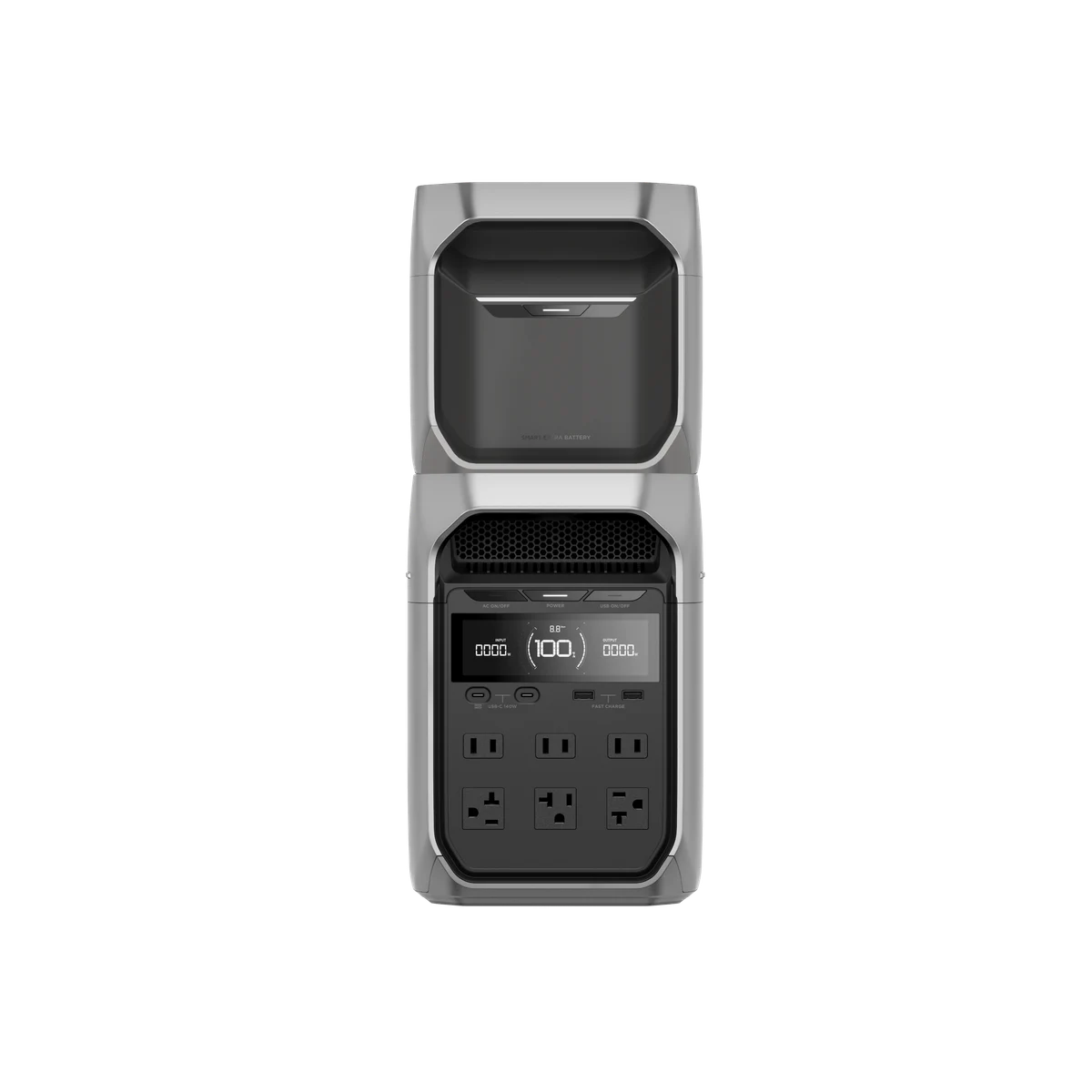
The US base DELTA 3 Plus is listed at 1,024 Wh and 1,800 W AC output. Optional system accessories change cost and handling, not just the headline capacity.
Manufacturer information informs the product details; the buying analysis is our own. This is not a hands-on test.The details at a glance
- Base capacity
- 1,024 Wh
- Rated AC output
- 1,800 W
- Purchase check
- DELTA 3 Plus, not another DELTA 3 variant
Keep the model and package names intact
Power-station families can contain similar names with different capacities, inputs and features. Do not shorten the model until those distinctions disappear. In this case the product is DELTA 3 Plus. A comparison written for another member of the DELTA 3 family cannot be transferred automatically because the enclosure looks familiar.
The official US offer identifies the base unit as 1,024 watt-hours with 1,800 watts AC output. Expansion bundles and other accessories appear alongside it. Read the selected option rather than treating the largest capacity anywhere on the page as the base specification. A larger advertised system may require additional hardware and a different budget.
Keep a small package inventory before purchase: station, charging cables, panels, expansion battery and any vehicle accessory you require. Mark which are included and which are optional. This prevents a product photo from silently becoming a shopping list you thought was already paid for. It also makes comparisons with other brands much fairer.
Normal output and special modes are not interchangeable
Manufacturers may describe enhanced-output or boost features separately from rated continuous output. Those modes can have device restrictions. Do not assume a boost label means every appliance above the ordinary rating will work normally. Check the exact supported load and operating conditions, particularly where voltage requirements are strict.
Build the initial plan around rated output and documented appliance requirements. Include startup demand and devices operating simultaneously. A short high-power task can challenge output without using much total energy; a small load running all night can do the opposite. This distinction helps identify whether you need a stronger inverter, more energy or neither.
We have not tested a refrigerator, tool or other appliance on this model. Avoid presenting a compatibility list as a guarantee based only on a wattage comparison. Device behaviour and manufacturer limits matter. If the application is critical, obtain appropriate technical confirmation rather than treating a generic “powers most appliances” claim as sufficient.
Expansion should solve a duration problem
An extra battery can extend a supported system’s energy reserve, but it adds another object, connection and charging consideration. If your normal task already fits within the base energy budget, immediate expansion may not be necessary. Keep the option available without assuming that buying the largest bundle is automatically the best value.
Check the exact compatible battery and cables. The presence of several expansion options on a product page does not mean every connection method is identical. Follow the current manufacturer instructions for the selected combination. Do not mix brands or improvised connectors simply because nominal voltage or a plug shape looks promising.
Think about deployment with all components attached. A base unit you can carry comfortably may become a setup that needs several trips from the car. Choose expansion when the additional duration matters enough to justify that routine. A tidy tabletop photo is not a demonstration of how convenient the complete system will be at your campsite.
Choose a charging route before an accessory bundle
Mains, solar and supported vehicle charging address different situations. If your trips involve long driving periods but little stationary sunlight, a panel bundle may not be the obvious first accessory. Conversely, a fixed outdoor setup has different priorities. Select the source that will actually be available rather than the most attractive system illustration.
Check electrical compatibility and installation requirements carefully. Some accessories require additional setup and are not a simple plug-in replacement for an ordinary charger. Compare the complete current package and regional socket version. We intentionally do not attach a discount claim that could expire or apply to a different bundle.
DELTA 3 Plus is worth investigating as a defined base station with supported expansion possibilities. The sensible buying path begins with the 1,024-watt-hour scenario you need today, then adds hardware for a genuine constraint. That produces a system you can explain and use instead of an impressive collection of accessories without a clear job.