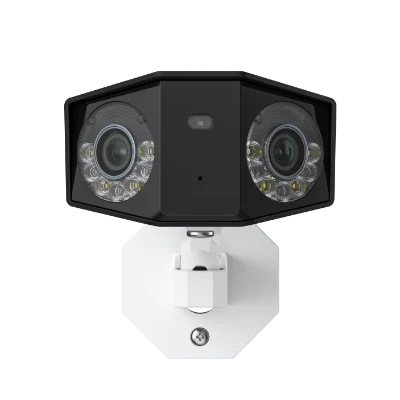
The published 180-degree horizontal view is useful for broad coverage. Plan the PoE connection and recording system before committing to the installation.
Manufacturer information informs the product details; the buying analysis is our own. This is not a hands-on test.The details at a glance
- Published resolution
- 7680 x 2160; marketed as 16 MP
- Horizontal field of view
- 180 degrees
- Connection
- Ethernet with supported PoE power
A panorama is an overview, not a close-up everywhere
Imagine a driveway with two parked cars, a footpath and a gate along the same frontage. A broad viewpoint can show the relationship between those places without requiring you to switch between feeds. That is the strongest reason to consider a panoramic camera: useful context across a wide area, rather than a guarantee of identifying every distant detail.
Resolution is distributed across the scene. A face close to the entrance and a number plate far across the drive occupy different amounts of the image. We have not tested identification at a particular distance. Decide where a detail really matters and consider whether a second, more focused viewpoint is appropriate instead of expecting one panorama to serve every job.
Check for occlusion as carefully as angle. A parked vehicle can hide a low target, and a porch column can block part of the scene. Mounting higher may improve the overview while changing the view of faces. Choose a position that answers your actual observation question, not simply the position that produces the widest-looking screenshot.
PoE is a system purchase
Power over Ethernet can carry network data and supported power through one cable. That can simplify the camera endpoint, but it shifts decisions to the other end of the run. Confirm that your switch, injector or recorder supplies the appropriate active PoE standard and power. Do not assume any device with an Ethernet socket can power a camera.
Plan the route from network equipment to the outdoor position. Cable protection, entry points and weather sealing matter. Follow the camera instructions for connectors and installation, and use qualified help when the work is beyond your competence. A weather rating for the camera body does not protect an exposed, poorly finished connection automatically.
If the route is impractical, that is a reason to reconsider the installation rather than buy the camera and hope later. A different mounting position, a professional cable run or a supported alternative model may be sensible. The camera can be attractive on paper and still be the wrong fit for a property with no suitable network path.
Choose the recording destination deliberately
The Duo 3 PoE supports recording approaches including continuous and event-based operation. Those options need a storage arrangement that matches your goal. If you want to review an entire afternoon, configure an appropriate schedule and verify playback. Seeing a live image on a phone does not establish that the timeline is being stored.
Check the exact supported memory-card specification, recorder compatibility and firmware requirements. A recorder from the same brand is not an unlimited compatibility guarantee. If integrating existing equipment, verify the particular camera and recorder combination before purchase. A useful comparison includes what you must add, not just the camera’s purchase price.
Plan how you would retrieve a clip. Footage stored only in the camera can be vulnerable if the device is damaged or taken; a separate compatible recorder creates a different arrangement. Neither approach is infallible. Test export and retrieval in advance, and decide who should have access to the recordings.
Build a commissioning checklist
After mounting, check the scene in daylight and darkness, with vehicles parked in their normal positions. Watch for glare, obstruction and a bright light pointing toward the lens. Manufacturer sample images do not recreate your driveway, so a first-night check is part of installation rather than an optional finishing touch.
Review recording, alerts and permissions separately. A useful recording schedule can coexist with a restrained notification schedule; you do not need an alert for every harmless movement. Frame your property responsibly and consider nearby private spaces. Apply privacy controls where supported, and consult applicable local requirements rather than relying on a universal rule.
The Duo 3 PoE is a reasonable direction for a homeowner who values a broad overview and can provide a wired infrastructure. It is less compelling when the cable, storage or mounting question remains unresolved. Solve those questions and you will know whether this camera belongs in your plan, without needing an invented star rating.