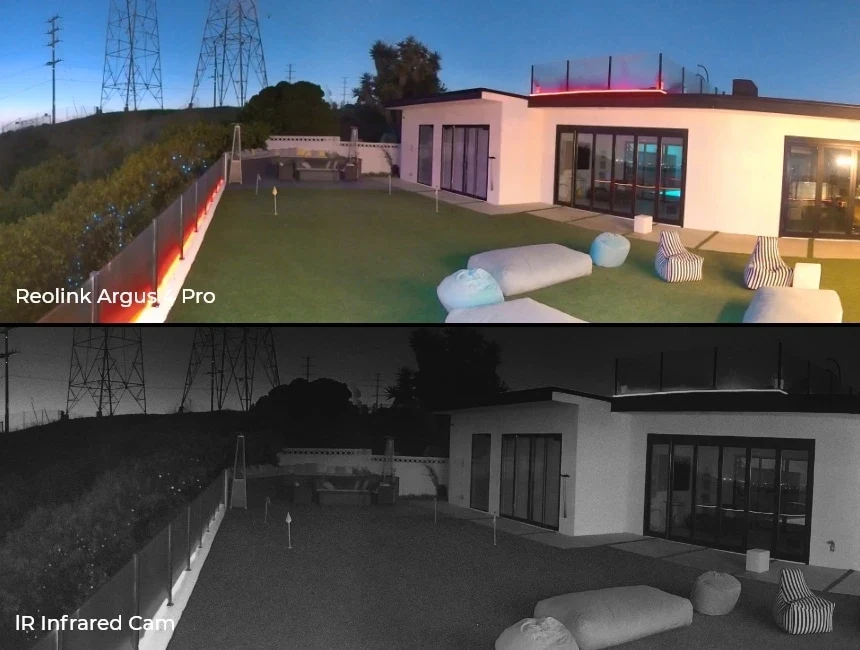
Check the real scene after dark. Lighting, distance, reflections and motion matter more than choosing a universal winner from a night-vision label.
Manufacturer information informs the product details; the buying analysis is our own. This is not a hands-on test.Decide what needs to remain visible
A night view can serve several jobs: spotting movement across a yard, seeing a visitor at the door or following a route around a parked vehicle. Those are different priorities. Mark the important zone and distance before considering a camera mode. An attractive wide scene is not enough if the person you care about occupies only a tiny part of it.
Look at the scene after sunset before installing anything. A porch lamp, streetlight and motion light may create pools of brightness with dark spaces between them. Record where a visitor actually walks. A location that looks balanced in daylight can place the relevant person in shadow or directly against a bright background at night.
Do not assume that a published resolution guarantees identification in that situation. We have not performed a distance or motion test on these cameras. Use the manufacturer specifications to shortlist, then evaluate the installed scene. If a detail is critical, a more focused viewpoint may be necessary alongside an overview.
Infrared and colour approaches ask different questions
Some cameras use infrared illumination for monochrome footage; others emphasize colour imaging using available light and suitable optics. The Duo 3 PoE and Argus 4 Pro illustrate different manufacturer approaches. That difference describes their designs, not an independently measured winner. The useful choice depends on how your own scene is lit.
A colour image can provide context such as clothing colour when conditions support it, but the word colour does not promise daylight-like detail in all darkness. Infrared has its own compromises and reflective surfaces can interfere. Compare the exact operating modes and lighting needs instead of treating one label as a complete performance score.
If a model uses visible auxiliary lighting, consider whether that light suits the household and nearby properties. Do not assume adding brightness is harmless or always beneficial. Its position can change glare and shadows, and its operation may disturb others. Use a proportionate arrangement that supports the observation you actually need.
Move away from the surfaces that fool the view
A nearby wall or overhang can dominate illumination and exposure. A camera looking past a close bright surface may struggle to present the darker background as you expect. Follow the installation guidance and inspect the resulting image at night. Small changes in angle can be more productive than repeatedly increasing a digital setting.
Shooting through glass introduces reflections and other complications. If outdoor monitoring is the goal, choose a supported outdoor installation rather than assuming an indoor camera behind a window behaves the same way. Never move equipment outdoors unless its rating and installation instructions allow it. The enclosure and connector arrangement matter as well as the lens.
Consider moving vegetation, spider webs and dirt near the lens or illumination source. These can create distracting activity or degrade the view. Plan safe access for cleaning and routine inspection. An unreachable camera is difficult to maintain, and image problems caused by the environment cannot always be fixed remotely.
Test a person in motion, not just an empty driveway
After installation, ask an authorized household member to follow the ordinary approach route and then review the stored recording. Static live footage and recorded motion can tell different stories. Check whether the important section is present, whether the subject remains visible and whether the recording mode captures the event you wanted.
Evaluate alerts independently from image quality. A clear picture is not proof that the selected detection rule will notify you about the right movement. Adjust supported zones and schedules with known events, and avoid promising perfect detection. Make sure the recording and notification settings match the purpose of the camera rather than simply leaving everything enabled.
Repeat the scene check when a new light is installed, foliage grows or the parking arrangement changes. Night performance is partly an ongoing property-management question. Buy a camera with appropriate documented features, but reserve time to make the actual viewpoint work. That is a more credible plan than choosing by a dramatic manufacturer night photograph alone.